Is it time for “TIME” analysis? And how does it link to APM
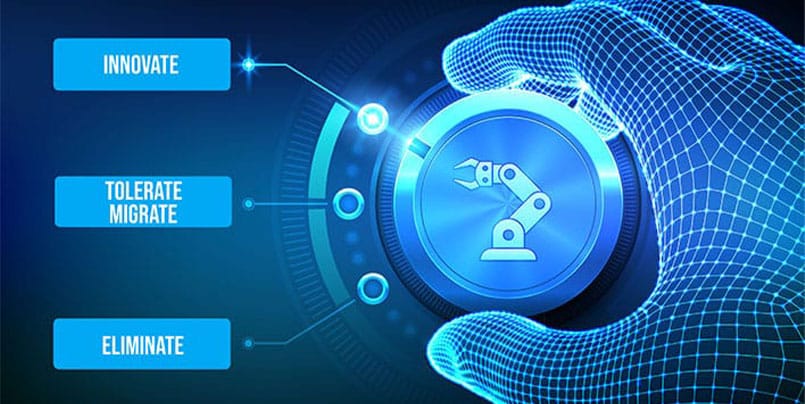
For years, the TIME framework (Tolerate, Innovate, Modernise and Eliminate) has been recognised as a practical way to classify business applications.
Originally made popular through early work on application portfolio modernisation, the concept has long since outgrown its origins. Today, TIME serves not only as a technical assessment model, but as one of the clearest and most effective communication tools within Enterprise Architecture.
TIME bridges the gap between current-state and future-state architecture, governance, and recommended decisions to reduce cost and ease business alignment; something that most stakeholders value far more highly than abstract discussions of value and frameworks, particularly in the era of AI. TIME endures because its four categories are intuitive to categorise business applications into four buckets:
Applications that fall under the Tolerate category have a high technical fit but a low business fit. They may not support business processes particularly well, may not enable AI and efficiencies, but may simply be easy to maintain at low cost to keep the lights on, such as simpler workflow systems or non-customer-facing systems that are more internal in nature. They are often maintained in their current state, despite their limited contribution to business goals.
The decision to tolerate an application often comes down to the cost and effort associated with replacing or upgrading it. If these factors outweigh the benefits of change, the application is tolerated until a more opportune time arises.
Invest applications are those with high technical and business fit. These applications are integral to the organisation’s operations and contribute significantly to achieving business objectives, supporting the strategic direction, and/or forming part of the target architecture. Further development of these applications will help ensure high-quality systems that are used daily and support important business operations.
The decision to invest in an application is driven by its potential to deliver increased value to the business. This could be through improved efficiency, enhanced functionality, or the ability to support new business initiatives. Investment might involve upgrading the application, expanding its use within the organisation, or integrating it more closely with other systems.
Migrate applications are those with low technical fit but high business fit. These applications perform important functions but are technically inadequate. They are typically replaced with more efficient, often cloud-based, alternatives. Think of old platforms like SAP, ServiceNow, Lotus Notes – these are all costly, but business cannot short-term operate without these systems.
The decision to migrate one or more applications is usually driven by the need to improve technical performance, reduce costs, or better align with the organisation’s business priorities and target architecture. Migration can be a complex process, requiring careful planning and execution to ensure minimal disruption to business operations; but the planning starts typically by assessments and roadmaps with recommendations done in Next-Insight or another collaborative solution.
Applications that fall under the Eliminate category have low technical and business fit. These applications, which perform poorly and are no longer aligned with business activities, are targeted for removal from the application portfolio.
The decision to eliminate an application is typically driven by the need to reduce costs, simplify the IT landscape, or mitigate risks associated with outdated software. Elimination can also be a complex process, requiring careful planning to manage dependencies and ensure a smooth transition for users.
While the definitions remain the same, has AI changed the meaning of TIME?
In a world where AI is becoming central to how organisations operate, Enterprise Architecture can no longer remain a passive discipline. CIOs and business leaders increasingly expect EA to play an active role in determining where and how AI should be applied to create measurable value for the business operations. This raises critical questions: where should AI be used, how should it be implemented, and what can be optimised or fundamentally improved? How to overview and make it transparent what the digital landscape consists of.
Used correctly, AI is not just another technology hype; it becomes an enterprise discipline. Organisations can now analyse, quantify and audit their processes with a level of depth and speed that was previously unattainable. When applied effectively, AI acts as a “flywheel“, delivering efficiency gains that outweigh the effort required to implement it.
However, this also introduces new responsibilities. Governance, accountability and regulation (for example, frameworks such as the EU AI Act, accountability for incorrect conclusions, as well as requirements for control and risk management) become central concerns. At the same time, AI fundamentally changes how organisations operate; enabling work to be done faster, processes to be optimised, and in some cases reducing the need for manual effort.
These considerations are inseparable from the application landscape. As AI is introduced into selected areas of the business, it inevitably drives changes across the application portfolio. Applications are no longer just supporting processes; they are actively shaping how work is performed and where efficiencies can be realised. These changes must therefore be guided by business priorities, while also reflecting technical fitness, operational resilience, security and target architecture.
This is where TIME proves its continued relevance. Modern TIME assessments go beyond purely technical classification. They incorporate business context, meaning that the business fit of applications must include their AI potential and their role in driving future efficiencies and providing a near-realtime digital twin. At its core, TIME provides a structured perspective (a set of weighted questions) that balances strategic business fit against technical viability: whether applications are AI-ready, strategic right, business aligned, process aligned against right technology choices such as target architecture fit, cost-efficient, vendor easy, secure and compliant.
What was once a one-off classification exercise conducted in spreadsheets has evolved into a living, digital process. Organisations that treat TIME as a static survey inevitably struggle with outdated insights and inconsistent decision-making. By contrast, those that operate TIME as a recurring workflow establish a rhythm of continuous improvement. Trends become visible, risks can be tracked, and the evolution of the application portfolio becomes measurable rather than anecdotal.
Modern practice is not a one-off
This shift from sporadic analysis to continuous governance is only possible when TIME is supported by a modern platform such as Next-Insight or a few other alternatives.
Many organisations still attempt to run TIME through spreadsheets, SharePoint forms or manual data collection in case-tools. The outcome is predictable: poor data quality, inconsistent scoring, and a process so resource-intensive that it is rarely repeated. TIME becomes a project rather than a capability.
In a modern EA practice, TIME should not stand alone. It should form a natural part of Application Portfolio Management, tightly integrated with strategic planning, cost transparency, risk evaluation and roadmap development. This is what we recommend using Next-Insight. A few changes to the questions, a workflow engine, and a delegation to relevant users to assist in the assessment to gather the necessary insights for architectural planning.
The process begins with a well-structured application portfolio, which can be done in Next-Insight as well. Not all systems should be treated equally. Business-critical applications, platforms, legacy systems, components and externally hosted solutions require different types of assessment. Remember to focus primarily on the Business Applications although assessments can be done also on components and external boundary systems.
This is where Next-Insight provides immediate value, offering a flexible and structured assessment approach designed for the realities of AI-driven organisations.
Governance and business ownership
Once the portfolio is properly structured, value is created by enabling the organisation to contribute. TIME is most effective when application owners, product managers and domain experts participate through a guided and standardised workflow. Questions must be clear, scoring must be repeatable, and weighting should reflect organisational priorities—whether that is architectural compliance, business value or cost efficiency.
This is where Next-Insight differentiates itself. TIME is not a static template or document—it is a built-in capability. Workflows can be activated rapidly, assessment models are configurable, and scoring can be weighted to reflect strategic priorities and governance requirements.
Data collection is automated, reminders are system-driven, and the application portfolio is continuously updated as assessments are completed.
The result is a level of governance that traditional EA tools (and certainly spreadsheet-based approaches) cannot match. TIME becomes continuous rather than episodic. Decisions are based on evidence rather than opinion, and Enterprise Architecture becomes directly relevant to business stakeholders.
From insight to action
One of the key strengths of TIME is its ability to translate complexity into clarity. It provides a visual and actionable overview of the application landscape: where to invest, what to modernise, and where technical debt is accumulating. This clarity enables faster and better-informed decision-making at both operational and executive levels.
Organisations working with Next-Insight benefit not only from visibility, but from alignment. TIME becomes a shared language between IT and the business, supporting prioritisation, governance and transformation initiatives.
Because the platform is low-code & low-consulting, you can do this assessment without demanding loads of consultants. The solution is designed to allow organisations can continuously refine their assessment models. In this way, TIME becomes what it was always intended to be: a strategic control mechanism rather than a technical exercise.
Moving into a faster world
As the pace of change accelerates, traditional EA approaches struggle to keep up. Next-Insight removes much of the friction associated with the transformation office by making TIME accessible to application owners, architects and executives alike. It enables organisations to move beyond static documentation and towards dynamic, data-driven decision-making.
For organisations ready to move beyond spreadsheets and one-off assessments, TIME can become a living part of the governance model rather than a forgotten exercise.
How we can help
We help organisations build EA practices with experienced consultants that secure rapid results, fast onboarding and delivery of results for e.g. TIME assessments quickly to support your strategy and transformation.
With Next-Insight we offer advisory, practice guidance and the #1 leading SaaS product in the market for strategy, business architecture and EA!
The platform is ready from day one and includes built-in workflows for TIME assessments and Enterprise AI planning—enabling organisations to move from insight to action with speed and confidence. Reach out for a call or demo.
(updated 2026)