Modern EA Exists to Transform Strategy into Execution
Modern Enterprise Architecture(EA) is fundamentally different from the modelling‑centric EA that dominated the early 2000s, a period defined by oceans of hand‑crafted diagrams and heavy frameworks. The purpose of contemporary EA is far simpler and far more strategic: to convert strategy into executable roadmaps, prioritisation logic, and board‑ready decision insights. EA succeeds only when it helps CxOs understand what needs to “split or fit”, what depends on what, and how the organisation can change safely, coherently and quickly.
Older styles of EA consumed years in documentation, aligning frameworks and crafting principles, often without materially improving decision‑making. Modern EA, especially when underpinned by platforms such as Next‑Insight, takes the opposite approach: rapid onboarding, cross‑organisational clarity, shared understanding and actionable transformation guidance for stakeholders pulling for more architectural knowledge. It operates as a dual‑purpose discipline, optimising the current state while co‑creating the future state with stakeholders. This is where the benefits materialise: faster revenue, lower costs, smoother acquisitions and post‑merger integration, and safer, cleaner transformation.
This article outlines the shifts CIOs and Chief Architects need to embrace within adoption of a modernised global standard rather than reading too detailed in library frameworks.
ISO 42010: The Most Overlooked Architecture Standard
For decades, EA teams argued about TOGAF, UAF, NAF, PEAF and other Architecture Frameworks (AFs). Yet the real challenge today is not choosing a framework, it is establishing a coherent and standardised practice with tooling that near-realtime describes architecture across the organisation.
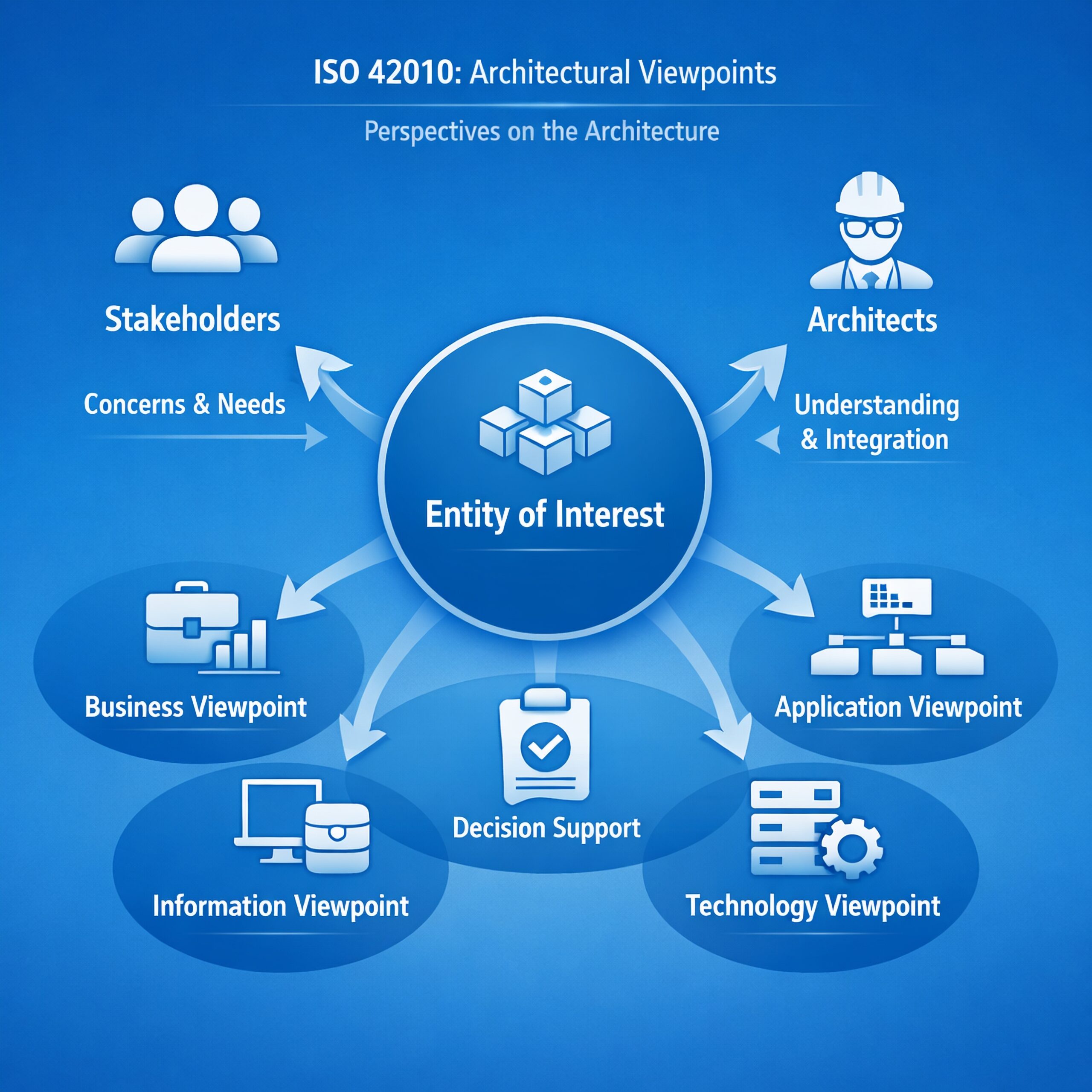
Despite the name of a “standard”, this is exactly what ISO/IEC/IEEE 42010:2022 provides. The latest edition formalises the Architecture Description Framework (ADF) and positions it as the meta‑layer upon which all Architecture Frameworks (AF) should rest. ISO 42010 defines stakeholders, concerns, viewpoints, model kinds and Architecture Descriptions, but it does not prescribe methods, governance models or notations. This neutrality makes the standard perfectly suited to the realities CIOs face: EA must support decisions, not create diagram archives, practices can choose a little bit from more frameworks, then still get it padded together.
Modern EA works only when stakeholders with interests and concerns pull the views they need to gain decision insight – not when architects push information models at them. That is why ISO 42010 is a release compared to many architecture frameworks, and why tools built around roles and viewpoints, like Next‑Insight, align naturally with the Standard.
As John Götze has summarised in a very informative article, it is a standard that that unifies methods. A parallel argument is now emerging from McKinsey. McKinsey emphasises that EA must adapt to agentic AI, collapsing planning horizons from years to months. This shift reinforces the value and speed needed to be supported by the standard, the argument is that only a method‑agnostic, viewpoint‑driven ADF can survive AI‑accelerated transformation.
Frameworks Are Libraries; Not Implementation Recipes
Traditional Architecture Frameworks (AFs) such as TOGAF, UAF, NAF and PEAF deliver structure, vocabulary and viewpoint catalogues, but most often, they do not deliver “adoption”, incrementality or operational sequencing. They function more like conceptual libraries than executable playbooks.
Few organisations use them “as written”, and even fewer have achieved end‑to‑end success by implementing TOGAF literally. This tension is reflected often in academia, often quoting that TOGAF is impractical (Kotusev). The observation is that Architecture Frameworks (AFs) define concepts, but they do not execute anything. Execution happens through tools, people, governance, data, and decisions and not through reading hundreds of pages of framework text.
McKinsey’s agentic‑AI research reinforces this point: incremental integration of new capabilities increases technical debt, while big transformations rarely get funded in one go. Most organisations must modernise architecture domain‑by‑domain, guided by tangible business benefit. Traditional AFs alone are not equipped to support that pace.
ADF: ISO 42010’s Hidden Masterpiece; The Framework for Frameworks
ISO 42010:2022 introduces one of the most powerful and overlooked ideas in EA: the Architecture Description Framework (ADF). It is not an AF. It is the structured way AFs should describe themselves.
ISO 42010 defines what consistency means, how viewpoints relate to stakeholders and concerns, and how Architecture Descriptions should be organised. The choice of stakeholders, views or governance structures remains the role of the AF, but ADF ensures that multiple frameworks can co‑exist coherently.
This matters because modern organisations increasingly combine eg.:
- UAF for mission‑ and capability‑oriented views
- enterprise AFs for strategy and operating models
- sector frameworks for compliance
- lightweight governance structures for digital transformation
ADF is what makes such hybrid architecture possible, interoperable and comprehensible. EA modernisation in the agentic‑AI era will be neither purely incremental nor fully transformational; most organisations will adopt a hybrid, domain‑led approach. An ADF‑aligned EA can actually much better support exactly that.
Modelling Languages Are Not Frameworks and And Never Have Been
One of EA’s persistent misconceptions is that modelling languages equal frameworks. They do not!
UML, ArchiMate, BPMN, SysML and DMN are modelling languages, powerful when needed, irrelevant when not. Just to clarify, ISO 42010:2022 mandates none of them!
Diagram‑driven EA has proven slow, specialist‑dependent and inaccessible to non‑technical stakeholders. Modern EA requires decision clarity for stakeholders, not notation fluency for the specialist consultants. This aligns with the logic we always advocate, see Why Clarity Matters , which argues that EA must be consumable, transparent and focused on tangible value.
Modern EA tools like Next‑Insight can use visuals and when needed, diagrams, but do not depend on them. They begin with stakeholders, connectedness, and insights — not boxes and arrows.
ISO 42010 Rejects the Requirements‑Centric World of TOGAF ADM
TOGAF ADM is built on a closed “Requirements Management” loop, a worldview inherited from classical systems engineering several decades back. But modern digital organisations move too fast for linear, requirements‑driven cycles. ISO 42010 defines:
- no lifecycle
- no requirements phase
- no ADM‑like sequence
It treats an organisation as an entity of interest that must be described clearly and consistently, not pushed through a cycle of steps. Modern needs are:
- strategy‑to‑execution guidance
- portfolio‑level decisions
- iterative clarity rather than linear method steps
This aligns with our messages to guide more than prevent progresss, see the article “Beyond Red Tape – Rolling Out the Red Carpet for EAM”, arguing that EA must shift from policing to guiding. This is also motivated by the progress of agentic AI, it accelerates change so rapidly that three‑to‑five‑year planning horizons collapse into much shorter timescales of months to stay relevant if EA needs to guide decisions ahead of execution.
Viewpoints Are Decision Engines — Not Diagrams
ISO 42010:2022 defines viewpoints as responses to stakeholder concerns. A viewpoint is the mechanism that gives a stakeholder the information needed to make a decision. A view may be a dashboard, dependency map, forecast, catalogue, narrative — or a visual, if appropriate.
This mirrors the mission‑centric logic of UAF as summarised recently. Although UAF is expressed in UML, real UAF practice is today mostly data‑driven, not diagram‑driven. What determines value is not the notation, but:
- the viewpoint
- the stakeholder
- the decision
Modern EA Tools Are Where Architecture Actually Happens
This is the decisive shift. Legacy EA tools were modelling platforms. Modern EA tools are architecture execution platforms. Platforms like Next‑Insight:
- visualises data from catalogues, forms and integrations
- connect relationships automatically on views
- generate viewpoints dynamically
- provide instant decision support
- onboard stakeholders in minutes, not months
- allow multiple AFs to co‑exist when needed
They create pull from the organisation because they deliver value immediately. EA becomes relevant from the first day, not as an after‑the‑fact clean-up exercise when the party is over, or the kitchen broke during the party.
EA should deliver proactive contributions to better and faster decisions, based on collaborative input across roles and domains. But if people do not mean the same when using the same words, information loses its value. Transparency and terminology must therefore be semantically aligned, and architects have a clear entity‑of‑interest in the correctness of these connected definitions. A simple example is the term “platform”, which often means entirely different things to business, IT, security, and vendors.
- In UAF, a platform is a military asset like a helicopter or ship.
- In a SaaS tools like Next-Insight, a platform is like Azure, Salesforce, SAP, or a mainframe domain.
- In ArchiMate, “platform” does not exist you need to specialise it.
- In ISO 42010, the word does not exist at all, because the standard operates at a higher meta‑level.
Conclusion: EA’s Future Is ISO 42010 Aligned and Tool Accelerated
Enterprise Architecture is shifting from documentation to insight, from diagramming to governance, from model production to decision support. Frameworks provide vocabulary. Modelling languages provide precision. But modern EA tools deliver impact.
ISO 42010 binds these worlds together, the universal grammar of stakeholders, concerns, viewpoints and architectural coherence. And here is the essence: Because ISO 42010 is interest‑ and viewpoint‑driven, not method‑ or diagram‑driven, modern EA tools like Next-Insight can implement it directly. This enables far faster adoption than framework‑centric EA. You do not need TOGAF, ArchiMate or ADM to start creating clarity for stakeholders. You need stakeholders, concerns and views; that is exactly what tools are built for, and that is what is now part of the global ISO standard. This is precisely the foundation needed for EA to operate at the speed demanded by digital business, stakeholder expectations and now also agentic AI.
Let’s connect if you require assistance getting started with your strategic planning and converting your overall strategic goals into planning that is aligned and realistic. Book a demo here.