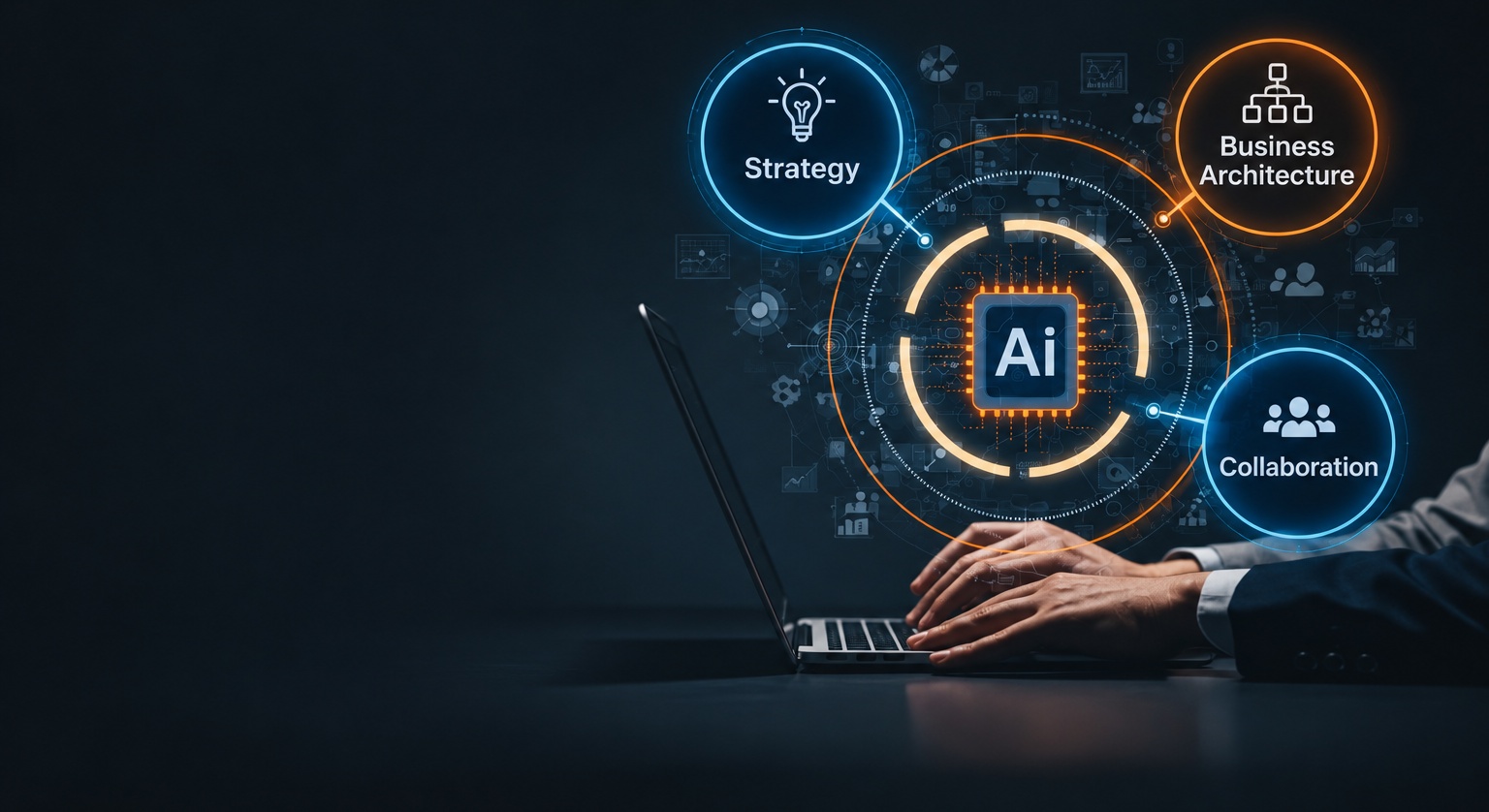
The modern interpretation of Enterprise Architecture (EA) follows an overall a set of four practices.
No executive wakes up in the morning wishing for more architecture. No CEO asks for additional diagrams. No CIO requests another repository. No investment board asks for more scenarios in a repository.
They typically struggle with overview and impact by drill-down. Modern Enterprise Architecture exists to answer a simple question to help with cohesion across silos and suboptimisation: How do we ensure hundreds of smaller decisions collectively move the organisation in the “right” direction?
Leaders invest in Enterprise Architecture because growth creates complexity. As complexity grows, leadership needs visibility, alignment and confidence that the organisation is moving in the right direction. As organisations grow, complexity grows with them. New products are launched. New systems are introduced. Regulations increase. Technology evolves. Local decisions are made every day across departments, projects and business units. Initially this creates growth, eventually it creates fragmentation.
Technology portfolios expand. Similar technical capabilities appear in multiple solutions. Different teams solve similar problems using different approaches and tools. Over time, duplication becomes difficult to identify and even harder to manage. Strategic priorities compete for attention. Investments become difficult to compare. The connection between strategy and execution becomes harder to see. The challenge is no longer activity. The challenge becomes coherence!
This is where modern Enterprise Architecture creates value. Not as a modelling discipline. Not as a repository. Not as a framework implementation. But as a management discipline that helps organisations maintain alignment while it adapts and changes continuously.
We advocate Enterprise Architecture has four connected practices that together provide the foundation that enables organisations to align strategy, deliver change, optimise technology and maintain a shared understanding of the enterprise. Let us explain these practices:
Strategy to Realisation
Every organisation has a strategy. The challenge is rarely defining it. The challenge is execution. Organisations rarely suffer from too little strategy. More often they struggle because new priorities emerge before previous ambitions have been fully realised. Strategic objectives often become disconnected from investments, initiatives and day-to-day decision-making. Different parts of the organisation begin optimising locally rather than collectively.
The Strategy to Realisation practice creates the link between ambition and execution. It connects objectives, capabilities, value streams, investments, initiatives and roadmaps into a coherent picture. This gives leadership visibility into where the organisation is heading, how it plans to get there and whether investments are strengthening the capabilities that matter most. The goal is not more initiatives, but the goal is better strategic alignment and execution to succeed.
Idea to Realisation
Every significant change starts with an idea. A new service. A new market opportunity. A regulatory obligation. A customer need. Many organisations generate more ideas than they can successfully execute. Business intent becomes disconnected from implementation. Requirements drift. Projects optimise locally. Value becomes difficult to realise. The Idea to Realisation practice provides the bridge between ambition and delivered outcomes.
It connects business needs, understand business requirements, validate the best solution design, secure the safe implementation and operational adoption into a continuous delivery journey. The purpose is simple: ensuring that every initiative contributes not only to local success but also to enterprise-wide objectives.
Systems and Technology Optimisation
Technology rarely becomes simpler over time. Applications accumulate. Platforms overlap. Technical debt grows unless management has eye on optimising. Operational costs increase unless we plan for cost take-out. Without active management, complexity expands faster than business value. The Systems and Technology Optimisation practice creates the visibility needed to continuously improve the technology estate. It helps organisations modernise legacy environments, retire redundant applications, reduce risk and focus investments where they generate the greatest value. This is not technology for technology’s sake.
It is about ensuring that technology remains an enabler of business outcomes rather than becoming a barrier to change.
Enterprise Knowledge, Governance and Metadata
The first practice focused on strategy, the second on delivery and design, and the third on continuous optimisation and adaptation. The fourth focuses on coherence as the overall glue, knowledge, governance and connectedness.
As organisations grow, knowledge becomes fragmented across departments, systems, projects and individual experts. Different terminology emerges. Ownership becomes unclear. Important decisions become difficult to trace. Gradually the organisation loses a shared understanding of itself. Modern Enterprise Architecture addresses this challenge by building connected enterprise knowledge.
This capability is key for modern enterprise architecture.
- Knowledge to create a shared understanding of reusable metadata of capabilities, systems, investments, responsibilities and decisions.
- Governance to have digital ownership, accountability, principles and decision processes.
- Connectedness to relate metadata and objects with a single source of truth
- Risk perspectives to grow the company at reduced risk levels.
- This is where Enterprise Architecture becomes truly enterprise-wide. The objective is not documentation. The objective is enterprise memory and decision support in feeding better data for humans and AI.
For many years Enterprise Architecture became associated with diagrams, frameworks and repositories. But they are not the destination anymore. They are simply tools. The real value of Enterprise Architecture is not found in a model; it is found in the decisions the knowledge and decision-support provided. Modern architecture starts with stakeholders and their concerns and interests. Concerns create the need for viewpoints. Viewpoints provide the insight required to make better decisions. When architecture helps leaders understand trade-offs, consequences, risks and opportunities, it becomes a strategic asset.
When it produces documentation that nobody consumes, it becomes overhead. The AI Era Changes the game; the rise of AI makes this even more important.
AI does not remove the need for governance. AI increases the need for connected and trustworthy enterprise knowledge. Both people and AI assistants increasingly require access to reliable information about processes, capabilities, systems, investments, ownership structures and strategic objectives.
Enterprise Architecture provides the context. AI helps consume it. Leadership remains accountable for the decisions.
From Complexity to Coherence
Modern Enterprise Architecture is not about producing architecture. It is about helping organisations maintain coherence while operating at scale. It connects strategy to execution.
It connects business and technology. It connects people, knowledge and decisions. Most importantly, it enables leaders to navigate complexity with greater confidence. Because organisations do not need more diagrams. They need more connected metadata and less documents.
Organisations do not need more diagrams; they need more alignment. They do not need more documentation; they need more understanding. Modern Enterprise Architecture provides the knowledge, governance and connectedness that allow leaders to make better decisions with greater confidence. In a world of growing complexity, coherence becomes a competitive advantage.
Next Step
Leading cloud-native service platforms such as Next-Insight make it possible to establish many of these capabilities out-of-the-box, including business architecture, strategic alignment, application portfolio management, technology portfolio management, governance, roadmaps, ownership structures and stakeholder-oriented viewpoints.
This allows organisations to focus on leadership, decision-making and execution rather than spending years of modelling maintaining documentation.
Instead of treating Enterprise Architecture as a large implementation programme, organisations can increasingly adopt architecture as a service, combining modern tooling, proven practices and pre-configured viewpoints to accelerate time-to-value and stakeholder adoption.
Organisations that succeed are rarely those with the most architecture. They are the ones with the greatest clarity, the strongest alignment and the ability to turn complexity into coherent action across departments. Modern cloud-native platforms such as Next-Insight make this possible by providing enterprise knowledge, governance, connectedness and decision-support capabilities out-of-the-box.
Reach out for a dialog…