How to Choose the Right Tool for building your Strategy & EA Practice
Maybe you have heard the advice:
“You need an Enterprise Architecture practice…”
That message is familiar to most CIOs and executive teams. It appears in analyst reports and board discussions, often positioned as a prerequisite for managing complexity, reducing risk, and executing strategy at scale to become data-driven with AI used at the right places in the organisation.
Yet when leaders ask the obvious follow-up question, what does that actually mean for us? the answers are rarely clear. In many organisations, Enterprise Architecture is delegated to a small, newly-formed or very senior team, often staffed with talented but relatively few architects. Eager to show progress, the team starts documenting the landscape and, quite naturally, looks for tooling to support that effort.
From the outside, that may look like momentum. From the inside, leadership still struggles with the same questions:
Why are some initiatives slow and risky?
Why are investment decisions hard to compare?
Why does strategy still break down before execution shows value?
The problem is mostly that the Enterprise Architecture has been introduced as a hiring activity without clear alignment to its mandate, purpose, and intended outcomes.
Until leaders are explicit about which decisions EA is meant to improve, which risks it should surface earlier, and how it supports executive steering, architecture remains disconnected, focused on clean-up and documentation after the fact, rather than acting as an invited partner in planning, governance and prioritisation.
This is why many EA initiatives stall, and why tooling decisions must align with mandate and practice expectations.
Building a viable Enterprise Architecture practice therefore does not start with buying or building a tool. It starts with intent, mandate, and clarity, and only then with selecting tooling that reinforces the practice and the outcomes leadership expects.
When these questions are answered it does make sense to discuss whether to buy, build, or onboard an EA tool, and what kind of tool can genuinely support the organisation’s strategic objectives.
Why successful EA practices start with intent
Enterprise Architecture tooling decisions are often made with the best of intentions, and with the worst possible timing. Faced with pressure to “do something”, organisations frequently turn to analyst rankings, feature comparisons, or procurement-led shortlists to decide which EA tool to buy. The result is usually disappointing. Adoption stalls, value remains unclear, and the tool quietly joins the growing portfolio of underused platforms.
The uncomfortable truth is that most EA tooling initiatives do not fail because the tools themselves are poor. They fail because organisations select tools before they have aligned on what they want to use them for, how they intend to work with them as a team, and how different roles within the architecture function are expected to coexist.
An EA tool is often a single platform, yet the people using it represent very different perspectives and skill sets. Solution architects are typically focused on immediate delivery. Domain and business architects work at a broader level, concerned with coherence and long-term direction. Strategists and enterprise architects operate with even longer time horizons, often preferring lighter and more portfolio-oriented governance and workflow options. Expecting one tool to satisfy all these needs without prior agreement is unrealistic.
Why Analyst Rankings Are the Wrong Starting Point
Without a shared understanding, tooling decisions are easily driven by those with the most urgent operational needs. Tools are chosen because they are immediately usable for modelling or documentation, rather than because they support the architectural capability the organisation is trying to establish. The real issue is rarely functionality. It is the absence of clarity about which information the EA function needs to master, for which use cases, and for which stakeholders. In some organisations, EA is seen primarily as a capability for architects themselves; in others, it is expected to serve digital management and the wider organisation as its core end-users. If this fundamental question is not aligned, it becomes totally irrelevant where a tool is positioned by analysts or how highly it is ranked in any market assessment.
At this point, many organisations default to analyst rankings or procurement-led comparisons, treating EA tools as if they were largely interchangeable. They are not.
Different tools embody fundamentally different philosophies of architecture and decision-making. The chosen tool may be “best in class” yet still fail because it encodes a way of working the organisation neither understands nor supports.
Too often, tooling decisions are then handed to procurement or justified by analyst rankings, where all tools are assumed to be broadly equivalent and compared on largely irrelevant criteria. This ignores the depth and complexity of architectural work. The result is predictable misalignment. The chosen tool may be “best in class”, yet it still fails because it encodes a way of working that the organisation neither understands nor supports.
Enterprise Architecture is not a product you install; it is a practice you develop. Tooling can accelerate that development, but only when it reinforces the culture, ambition, and role that EA is meant to play. Successful EA practices therefore follow a sequence.
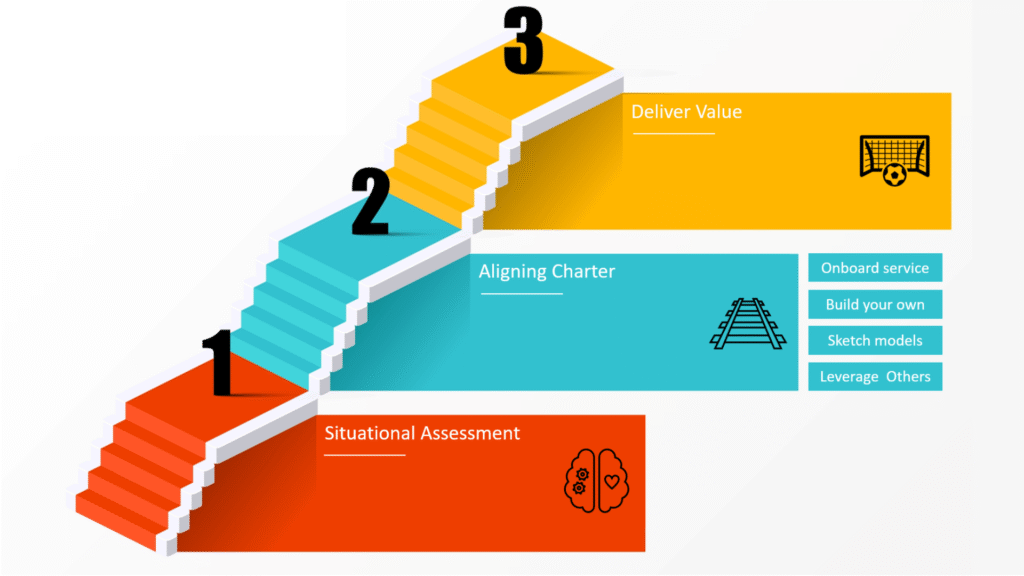
We can outline a 3-stages development approach to select properly.
Stage 1: Situational Assessment
Most EA journeys begin in an ad-hoc state. Architecture exists in fragments: slide decks, spreadsheets, isolated models, and undocumented decisions. Architects are invited in late, asked to explain outcomes they had no influence over, and expected to impose order after the fact. Governance may exist on paper, but it is rarely traceable or lived.
At this stage, EA is reactive. The organisation does not yet share a clear understanding of what EA is for, or how it creates value. Introducing tooling here is premature. Without trust, mandate, or clarity of purpose, even the most capable tool will be perceived as overhead rather than support.
The appropriate step in this phase is a situational assessment. This is not a theoretical maturity exercise, but a practical examination of how decisions are made, where friction occurs, and what stakeholders struggle with. The goal is to establish a shared and honest view of the current state, creating the foundation for meaningful progress.
Stage 2: Aligning the Charter
Only once the organisation understands where it is can it decide what it wants EA to become. This second stage is the most critical, and the most commonly rushed.
Aligning the EA charter is fundamentally about intent. It requires answering a deceptively simple question: who is Enterprise Architecture for in this organisation, and what role should it play?
Some organisations want EA to function primarily as an advisory capability, offering independent insight and challenge. Others expect EA to facilitate cross-organisational planning and management decision-making. Some focus on architectural coherence as an internal discipline, while others want EA to actively drive execution and measurable outcomes.
These are cultural choices. Each implies a different way of working, a different relationship with stakeholders, and a different balance between detail and abstraction. Until this is agreed, tooling discussions are at best speculative and at worst actively harmful.
This is also the point at which tooling becomes relevant, not as a procurement exercise, but as a strategic enabler. Different categories of EA tools embody different assumptions about how architecture work is done and who it serves. Choosing between them is in effect choosing what kind of EA practice the organisation is prepared to support.
- Ready-made Onboard Service like Next-Insight favour speed, shared language, and rapid stakeholder engagement.
- Highly configurable tools such as MooD, other case-tools or low-code options suit organisations that value control, bespoke modelling, and build-your-own portal with long-term ownership.
- Notation-driven sketching tools such as Sparx, Archi or others support rigorous internal craftsmanship but often struggle to engage business stakeholders.
- Using a patchwork of generic tools to leverage with others may keep things moving temporarily, but it rarely supports a sustainable practice.
These paths are not interchangeable. Each reinforces a particular culture and mindset. Selecting a tool that conflicts with how the organisation works almost guarantees frustration and underperformance. For instance, if the main objective is to have a digital twin, then look for solutions that offer a digital twin model right out of the box. If you main need is solution architecture, be explicit about the differences before and what intersection that exists between enterprise and solution architecture.
Stage 3: Delivering Value
When culture, charter, and tooling are aligned, EA can finally focus on what matters: delivering value. Architecture shifts from explaining decisions after the fact to shaping options early, supporting trade-offs, and enabling coherent execution across the enterprise.
In this stage, the tool fades into the background. It becomes part of the operating environment, supporting transparency, traceability, and collaboration. Stakeholders engage with it because it helps them make better decisions, not because they have been instructed to use it. Architecture insights become visible, relevant, and connected to outcomes that matter to the business.
This is where EA earns trust, credibility, and longevity, but only because the earlier steps were taken seriously.
Tooling as an Amplifier
The most common mistake in EA tooling is to treat tool selection as a starting point. It should be an accelerator or amplifier for doing more, simpler and automated. A consequence of understanding your current situation, aligning on the role and ambition of EA, and being honest about your culture and architecture skills in the team.
When that sequence is respected, tooling becomes a powerful accelerator. When it is ignored, even the most highly rated tool becomes an expensive obstacle. If the tool can support any notation, but your team members don’t have such skills, most respected tools will be seen as cumbersome and complicated. Very often the requirement phase adds new requirements “for free” meaning the choice of end-product is so rich on features that only a few can learn to master it.
We work with organisations to assess their current state, align their EA charter, and choose tooling that genuinely supports the practice they want to establish. Our focus is on helping EA functions succeed, by matching intent, culture, and capability with the best tooling options available in the market.
If you are looking to build or reset your Enterprise Architecture practice and want advice grounded in experience rather than market hype, we would be happy to talk.
Our focus on helping EA functions succeed, by matching intent, culture, and capability to maximise impact.
We offer leading tools for fast-tracking EA; but we also offer support of case-tools where the need for notation and free metamodeling is key. Reach out for advice.