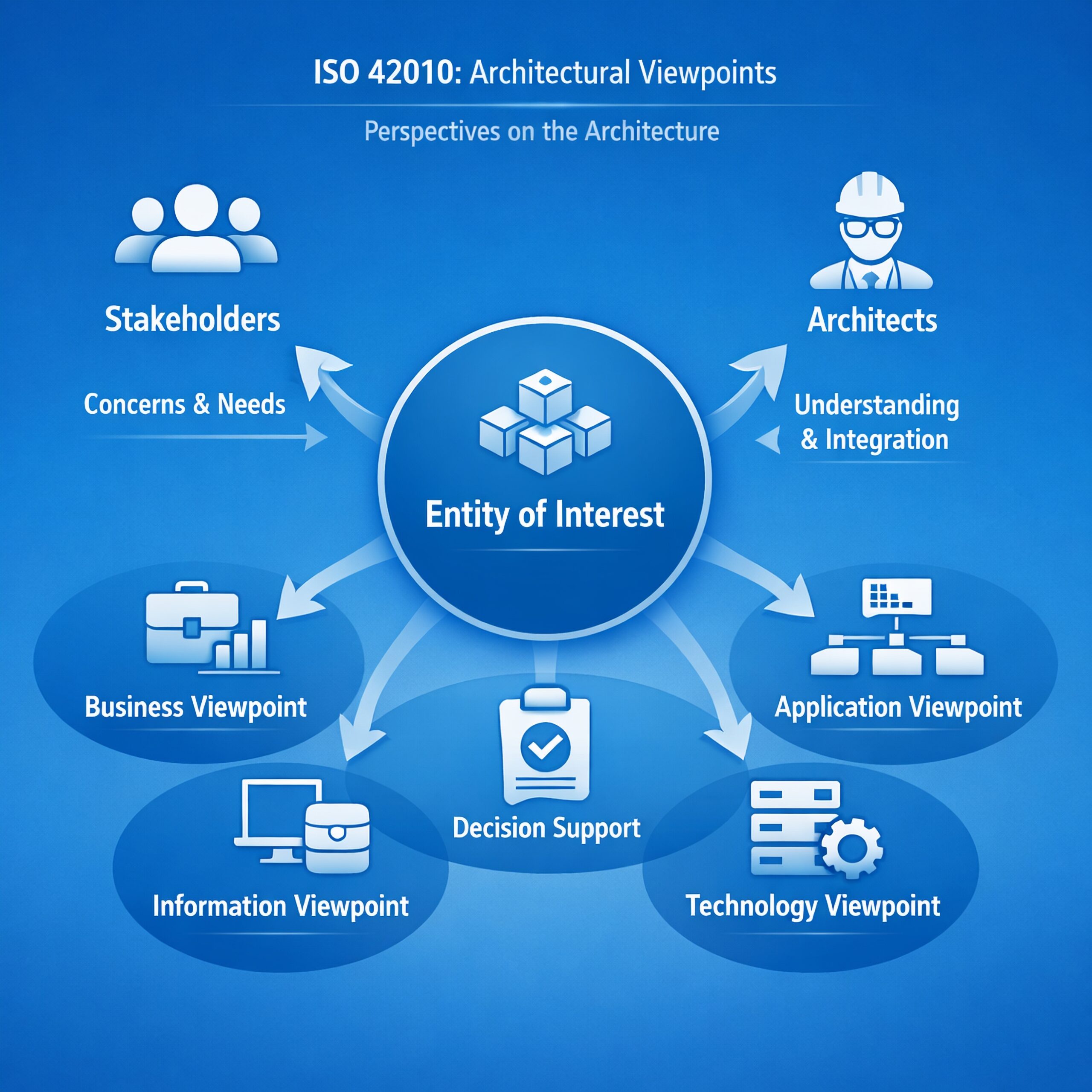


Most leadership teams know the feeling. The organisation is busy, delivery speed is high, and initiatives keep flowing, yet a fundamental strategic question lingers: are we moving in the right direction? Backlogs grow, teams accelerate, and dashboards glow green. What remains unclear is whether today’s prioritisation choices strengthen the enterprise’s ability to compete tomorrow.
The issue is rarely execution capacity, it is strategic visibility. When leadership lacks a connected view of goals, capabilities, investments, and consequences, speed often becomes a substitute for direction. Decisions are made continuously, but without a shared structural understanding of what truly matters now; and what must still matter three years from now.
Enterprise Architecture (EA) was never intended to exist for documentation’s sake. At its core, EA exists to connect strategy to execution, enable informed prioritisation, manage risk and compliance through reusable insights, and provide a shared knowledge foundation across the enterprise.
Over time, however, EA drifted inward. It became technical, specialist-driven, and artefact-heavy. Leadership learned to steer without it, relying instead on PMOs, BI reports, experience, and politics.
Architecture survived as a discipline, but its strategic role eroded. Business Architecture, although inherently connected to IT architecture, often drifted into its own silo. The result is not a lack of architecture, it is a lack of architecture that actually helps leaders decide.
An organization is always making decisions. There is no “neutral state” or waiting zone. If Enterprise Architecture does not actively support decision-making, decisions simply route around it. What fills the vacuum are PMOs, TMOs, dashboards, and fragmented insights; each useful in isolation, none structurally connected.
This creates knowledge without causality. Activity without coherence. Architecture may exist, but it is not pulled into the moments that matter. A clear symptom is when called to explain what went wrong, “after the party”, not part of “planning the party”.
As Gartner analyst Austin Steinmetz has observed, despite Business Architecture sitting at the crossroads of business and IT, much of the guidance and tooling is today perceived by its primary customers, business stakeholders as non-consumable. When insight cannot be consumed, it cannot influence outcomes.
Modern EA is fronting business with Business Architecture, sometimes labelled Strategy-to-Execution (S2E) as the cockpit of architecture, and it represents a clear break with the past.
Architecture without decision pull for it’s main customer audience is waste. Decisions without architecture are risk. Strategy-to-Execution insists on both.
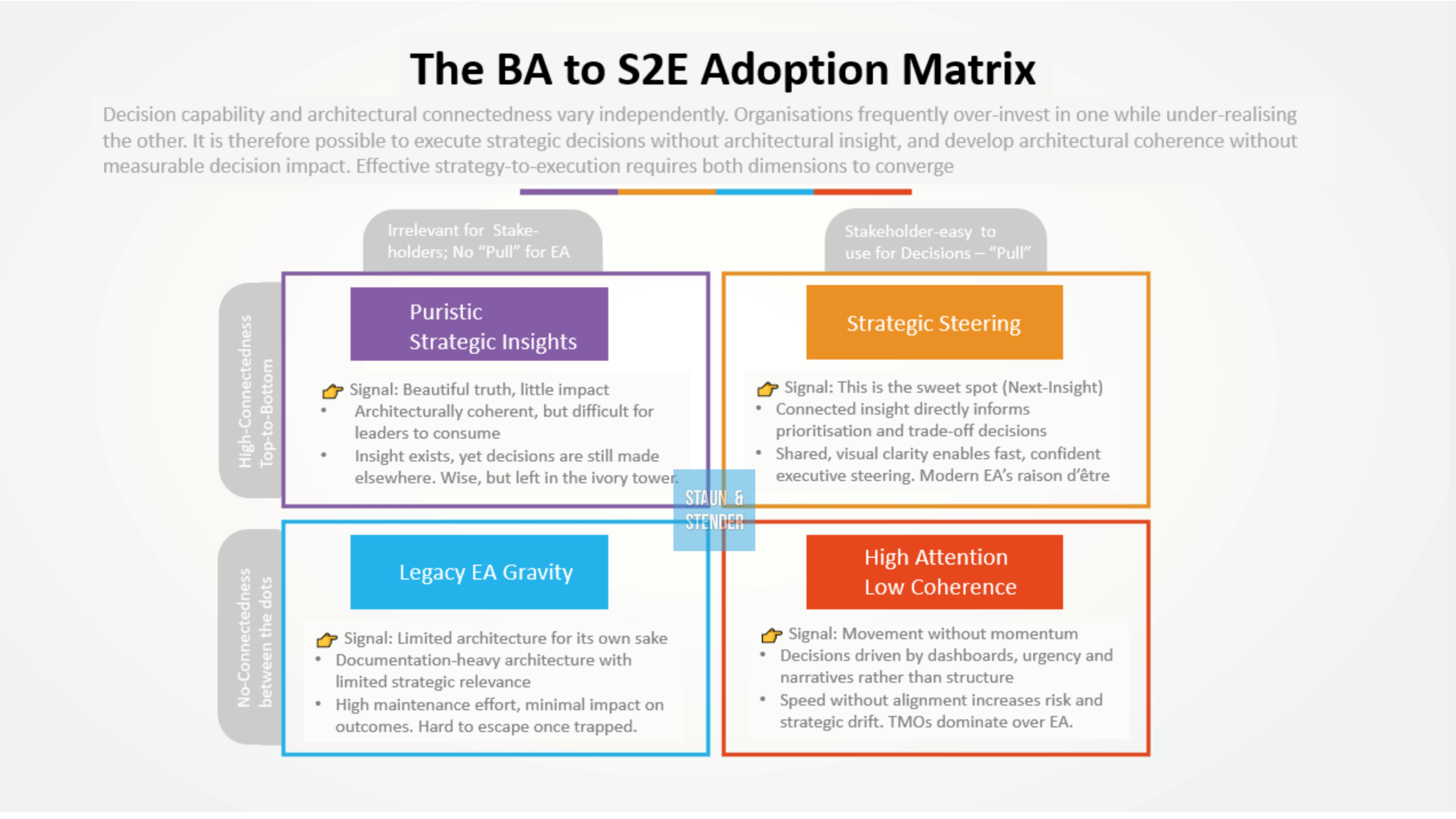
To understand why many EA efforts stall, two independent dimensions must be considered simultaneously.
Traditional EA tools often score high on connectedness but low on decision pull. This is exactly what Gartner’s Analyst has highlighted in its analysis of classical EA platforms.
Conversely, many executive teams operate with high attention but low coherence, steering through slides and KPIs without structural grounding.
Strategic steering exists only where both dimensions are high. This is the space Strategy-to-Execution occupies — and where modern platforms such as Next-Insight are deliberately positioned.
Organisations can only steer effectively when strategic intent is visible in everyday decisions. In S2E, leadership continuously scores and weights strategic goals, the North Star, reflecting a time-varying set of strategic goals. This forces explicit trade-offs and aligns the organisation around what truly matters now.
Capabilities translate intent into structure. As stable expressions of what the business does (or must become capable of doing). Capabilities absorb strategic priorities and provide a durable lens for investment decisions.
Initiatives become contributors to capability development rather than isolated projects competing for attention. Leadership steers the what and the why. Development teams and product teams then decide the how. Alignment emerges without micromanagement.
The traditional Magic Quadrant (MQ) for EA tools primarily evaluates architectural maturity: repository strength, modelling depth, and the ability to connect structural elements efficiently, supporting frameworks and notations. Some tools excel on this axis (vertical), becoming increasingly sophisticated environments for architects.
What the MQ does not evaluate is stakeholder-centric decision support (horizontal): consumability by the organisation, collaboration at scale, and near real-time decision readiness. When the focus shifts toward lowering barriers and increasing pull from business stakeholders, different platforms emerge.
This is where tools and practice meet. The emphasis moves from architecture for architects to architecture for steering. From connecting dots to enabling decisions. Next-Insight is delivered as a service with the DNA to elevate architecture into a leadership instrument.
Strategy-to-Execution activates both critical dimensions simultaneously. With services around Next-Insight, organisations achieve deep architectural connectedness and high decision value that is easy to consume, is good-looking, and sustainable in structure and information. Architecture becomes simple, visual, and immediately usable. The many contribute; the few steer. Insight is continuously updated; not quarterly translated at reviews looking back.
Enterprise Architecture is no longer something to be drawn or debated. It is something to be used. Governance and compliance emerge as outcomes of clarity, not as primary objectives. EA becomes leadership infrastructure.
If leadership cannot answer at any moment what the organisation is strengthening, what it is weakening, and why, then speed is not an advantage. It is a risk.
Strategy-to-Execution is not about doing more. It is about deciding better to optimise the current, direct the future, and ensure compliance along the way.
The future of Enterprise Architecture will not be won in repositories or diagrams. It will be won where leaders gain clarity, alignment, and confidence in their decisions. That is where Strategy-to-Execution lives, and where modern platforms like Next-Insight quietly redefine what modern Enterprise Architecture is meant to be.
When insight is missing, decisions are still made; often fast, often confident, and too often without a data-driven foundation.
Get started today by requesting your Next-Insight demo and experience how we can help you making EA and Business Architecture relevant from Day 1. If you would like to talk first, do not hesitate to contact us.
Sign up below and receive a whitepaper on how to start your Business Architecture today. You will receive the whitepaper in your provided e-mail.
*Mandatory fields
Sign up below and receive a whitepaper on how to scale your Enterprise Architecture. You will receive the whitepaper in your provided e-mail.
*Mandatory fields